

Is Toothpaste With Dietary Supplements Effective?
Table of Contents
- What Supplement Toothpaste Claims to Do (and What Science Supports)
- Benefits of Vitamin B12 Toothpaste: Hype or Helpful?
- Oral Microbiome Friendly Toothpaste: Why Bacterial Balance Matters
- FDA Regulation of Oral Care Products: What's Actually Verified
- How Supplement Toothpaste Interacts With Your Regular Routine
- Dosage Limits, Bioavailability, and Ingredient Red Flags
- Frequently Asked Questions
Last Updated: October 4, 2026
What Supplement Toothpaste Claims to Do (and What Science Supports)
The question of is toothpaste with dietary supplements effective comes down to one distinction most product labels blur: what happens on your teeth versus what happens inside your body.
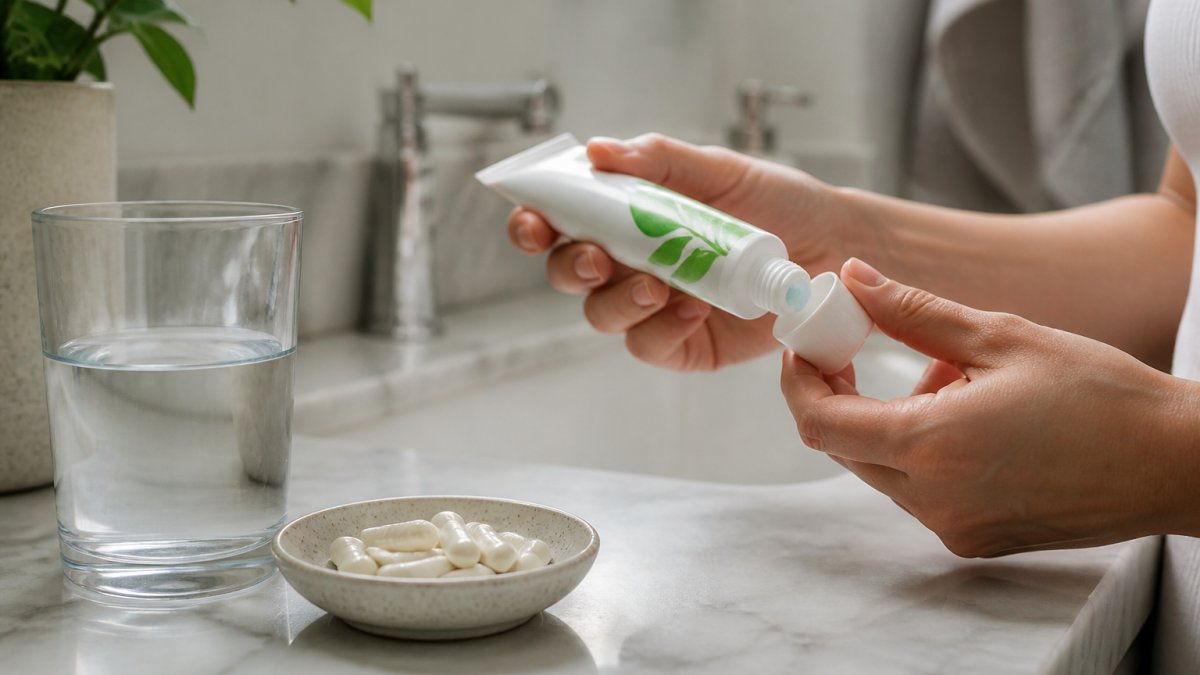
Supplement toothpaste is an oral care product that adds vitamins, minerals, probiotics, or plant extracts to a standard cleaning formula. The idea is that these ingredients do more than polish teeth.
That last part is where things get complicated. A nutrient has to cross the oral mucosa to reach your bloodstream. Most toothpaste gets spit out within two minutes.
The Difference Between Topical and Systemic Delivery
Topical delivery means an ingredient acts where you put it, on the surface of teeth and gums. Systemic delivery means it enters your bloodstream and travels through the body.
Most proven oral care benefits are topical. Fluoride, for example, works by strengthening enamel directly. It does not need to enter your blood to help.
According to the FDA's guidance on oral care drug products, toothpaste ingredients that make drug-like claims must meet specific evidence standards. That is a useful filter when you read a label.
Benefits of Vitamin B12 Toothpaste: Hype or Helpful?
Vitamin B12 toothpaste is marketed as a way to boost energy and support nerve health through brushing. The honest answer requires understanding how B12 actually gets into your body, because the route matters more than the ingredient.
Why B12 Is Hard to Absorb Anywhere
B12 is one of the largest and most structurally complex vitamins. In a normal digestive pathway, it does not absorb on its own. It must first bind to a protein called intrinsic factor, which is produced by cells in the stomach lining, and the pair is then absorbed in the final section of the small intestine. That multi-step process is why oral B12 supplements are usually dosed in high micrograms, often 500 mcg to 1,000 mcg or more, even though the daily recommended intake for adults is only about 2.4 mcg.
Can B12 Cross the Oral Mucosa Instead?
There is a secondary route: a small amount of B12 can pass directly through the mucous membranes of the mouth and under the tongue, bypassing the gut entirely.
That is the theory a B12 toothpaste leans on. The problem is contact time. Most people brush for roughly two minutes, and the paste is diluted by saliva and then spit out. A sublingual tablet sits in a concentrated pool against the same patch of tissue for minutes.
What the Evidence Actually Shows
There is no widely accepted clinical evidence that brushing with a B12 toothpaste raises serum B12 levels enough to correct a deficiency. The studies that support oral B12 as a treatment for deficiency use swallowed tablets or sublingual forms, not dentifrice.
Where a B12 toothpaste might help is comfort and routine, not deficiency correction. If you like the taste and it keeps you brushing, that has value. Just do not count on it to fix low B12.
Who Actually Needs B12, and How They Should Get It
Certain groups are at higher risk of true B12 deficiency: adults over 50, people who follow strict vegan or vegetarian diets, anyone who has had gastric bypass or other stomach surgery, people with Crohn's disease or celiac disease, and long-term users of certain acid-reducing or diabetes medications. For these groups, the standard approach is a blood test followed by a prescribed oral dose, an injection, or a nasal gel, not a toothpaste.
The Bottom Line on B12 Toothpaste
If you already get enough B12 from food or a swallowed supplement, a B12 toothpaste is unlikely to add anything measurable. If you suspect you are deficient, the toothpaste is the wrong tool. The ingredient is real; the delivery method is the weak link.
Oral Microbiome Friendly Toothpaste: Why Bacterial Balance Matters
Oral microbiome friendly toothpaste is designed to support the good bacteria in your mouth instead of wiping out everything.
Your mouth hosts hundreds of bacterial species. Some cause decay and gum disease. Others help keep the harmful ones in check.
A balanced approach favors gentle cleansing and ingredients that support the good bacteria. This is where probiotic intervention in oral care is gaining attention.
Common microbiome-friendly ingredients include:
- Propolis, a resin made by bees with antibacterial properties
- Probiotic strains that may support gum health
- Plant enzymes that break down plaque without harsh scrubbing
- Xylitol, a sweetener that some bacteria cannot use for energy
Research into the NIH overview of the human microbiome shows that bacterial balance affects far more than your mouth.
FDA Regulation of Oral Care Products: What's Actually Verified
FDA regulation of oral care products splits toothpaste into two broad buckets: cosmetics and drugs. That split decides what a company can legally claim.
Plain toothpaste that only cleans is treated as a cosmetic. It does not need pre-market approval. Toothpaste that claims to fight cavities, reduce plaque, or treat gum disease is treated as an over-the-counter drug.
Here is the practical takeaway for shoppers:
| Claim Type | FDA Category | What It Means for You |
|---|---|---|
| Cleans teeth, freshens breath | Cosmetic | No proof of health benefit required |
| Fights cavities, reduces plaque | OTC drug | Active ingredient must meet FDA standards |
| Boosts immunity, fixes deficiency | Not an approved drug claim | Treat with caution |
The word "clinically validated" on a label is not a regulated term. It can mean many things. Look for specifics: what was tested, on how many people, and where the results were published.
How Supplement Toothpaste Interacts With Your Regular Routine
Switching to a supplement toothpaste does not mean abandoning proven habits. The smart move is to layer it into what already works.
Keep these basics in place:
- Brush twice a day for two minutes
- Floss daily to reach between teeth
- See a dentist for regular checkups
- Use fluoride if your dentist recommends it for cavity protection
If you use a fluoride toothpaste and a supplement toothpaste, do not mix them in one brushing. Use one in the morning and the other at night.
A common mistake is quitting fluoride entirely because a natural product feels gentler. Fluoride remains one of the most studied ingredients for cavity prevention. If you drop it, replace that protection with something your dentist approves.
Dosage Limits, Bioavailability, and Ingredient Red Flags
Bioavailability is the share of an ingredient your body can actually use. A label can list a nutrient and still deliver very little of it in a form you can absorb. This is the gap between what is printed and what reaches your cells, and in toothpaste, the gap is unusually wide.
The Pea-Sized Problem: How Much Can Actually Fit
A standard recommendation is to brush with a pea-sized amount of toothpaste, roughly 0.25 grams. That is the entire delivery vehicle for every 'active' ingredient on the label.
Run the math against a daily value.
This is the constraint most supplement toothpaste marketing avoids. A label can be technically accurate and still describe an amount too small to matter systemically.
Local vs. Systemic: Two Different Jobs
It helps to separate what a supplement ingredient can do in two places:
- Locally, on teeth and gums, an ingredient like xylitol, a probiotic strain, or a plant enzyme can act on the surface where it lands. This is where most plausible oral care benefits live, and the dose needed is often small.
- Systemically, inside the body, an ingredient has to cross the oral mucosa or be swallowed in sufficient quantity to change blood levels. For most vitamins and minerals, a pea-sized topical dose is nowhere near enough.
A product that supports gum comfort through a local mechanism is making a very different claim than one that says it raises your vitamin levels. Read the label with that split in mind.
Do Supplements Interfere With Fluoride or SLS?
This is a real formulation question, not a marketing one.
- Fluoride works by reacting with tooth enamel to form a harder mineral surface. Ingredients that bind calcium or phosphate, including some calcium-based supplements and certain plant extracts, can compete with that reaction if they are present in high enough concentration. In practice, most supplement toothpastes contain too little of these to blunt fluoride, but a product that lists a large mineral load alongside fluoride is worth a closer look.
- SLS (sodium lauryl sulfate) is the foaming agent in many conventional pastes. It does not interact with most vitamins, but it can be harsh on people with recurring mouth ulcers or sensitive gums. Many supplement toothpastes drop SLS for that reason, which is a legitimate formulation choice rather than a supplement benefit.
- Probiotics are the most fragile addition. Live strains can be damaged by strong surfactants, high fluoride concentrations, or prolonged shelf time. A probiotic toothpaste that does not state a strain count at the end of shelf life is making a claim it may not be able to back up.
If you use a fluoride toothpaste and a supplement toothpaste, do not mix them in one brushing. Use one in the morning and the other at night. This keeps the fluoride working and gives the supplement formula its own contact time.
Verified vs. Unverified: A Quick Ingredient Filter
Not all supplement ingredients in toothpaste are equal. A rough split:
Better-supported for local oral use:
- Xylitol, well studied for reducing cavity-causing bacteria
- Fluoride, the most studied cavity-prevention ingredient in dentistry
- Certain probiotic strains, emerging evidence for gum health, though strain-specific
- Stabilized stannous fluoride or potassium nitrate, proven for sensitivity
Plausible but thinner evidence:
- Propolis, antibacterial in lab settings, less consistent in clinical use
- Plant enzymes, mechanism is reasonable, human trials are limited
- Aloe vera, soothing, but not shown to change oral disease outcomes
Marketing-first, evidence-light:
- 'Immune-boosting' vitamins in a rinse-and-spit format
- Herbal blends with no listed amounts
- Any claim to 'reverse' decay or 'heal' gum disease
Red Flags on the Label
Watch for these:
- Vague claims like 'supports wellness' with no detail
- No ingredient amounts listed on the label
- 'Proprietary blend' that hides how much of each item is inside
- Cure language such as 'heals gum disease' or 'reverses decay'
- No third-party testing or published results
- No strain or CFU count on a probiotic product
At PROTEITH®, we built our formula around proteolytic technology and microbiome-friendly ingredients, free from harsh abrasives and artificial additives. Our focus is support, not miracle claims.
If you already take supplements and use a solid toothpaste, ask whether a combined product adds real value. Sometimes the answer is yes, and sometimes separate, proven routines are the better path.
Frequently Asked Questions
Is Vitamin B12 absorption through toothpaste effective?
Research on mucosal absorption suggests some B12 can pass through the oral mucosa into systemic circulation, but the amount is far lower than what you'd get from a sublingual tablet or injection. Supplement toothpaste may contribute small amounts of B12, particularly for people with mild deficiency, but it should not replace a doctor-recommended supplement regimen. If you have a diagnosed deficiency, speak with your healthcare provider about appropriate dosing.
Does the FDA regulate supplement toothpaste the same way as regular toothpaste?
The FDA regulates toothpaste as a cosmetic product under the Federal Food, Drug, and Cosmetic Act, which means it does not require pre-market approval for most ingredients. If a toothpaste makes therapeutic claims, such as reducing gingivitis, it may be classified as an over-the-counter drug and must meet stricter requirements. Products marketed as dietary supplements fall under separate FDA rules for supplements. Always check whether a brand discloses its regulatory classification and ingredient sourcing.
Can oral care products contribute to systemic health?
The oral cavity is connected to the rest of the body through the bloodstream and digestive tract. Conditions like periodontal disease have been associated with cardiovascular issues and diabetes in observational studies. However, the evidence for toothpaste delivering meaningful systemic benefits is limited. What matters most is maintaining good dental hygiene, reducing plaque, and addressing gum inflammation. A supplement toothpaste may support those goals, but it is not a substitute for professional dental care.
Are natural ingredients in toothpaste as effective as synthetic ones?
It depends on the ingredient and the formulation. Some natural compounds, such as propolis and certain plant extracts, have demonstrated antibacterial properties in laboratory studies. Fluoride remains the most extensively studied ingredient for cavity prevention. When evaluating a natural toothpaste, look for evidence-based ingredients and clinical validation rather than marketing claims. A product that combines proven ingredients with a microbiome-friendly approach may offer advantages for gum health and enamel protection.

