

Probiora vs Superteeth for Teeth: A 2026 Guide
Table of Contents
- Probiora vs Superteeth for Teeth: Quick Comparison
- How Dental Probiotics Work in the Oral Cavity
- Probiora vs Superteeth: Strain-by-Strain Breakdown
- Best Dental Probiotics for Gum Health: What to Look For
- Benefits of Proteolytic Enzymes for Teeth and Gums
- How to Improve Oral Microbiome Alongside Probiotics
- Cost, Convenience, and Daily Routine Fit
- Conclusion
- Frequently Asked Questions
Last Updated: September 12, 2026
Probiora vs Superteeth for Teeth: Quick Comparison
Choosing between Probiora vs Superteeth for teeth comes down to one question: do you want a chewable probiotic tablet, or a toothpaste built around enzymes? Probiora leans on dissolvable probiotic tablets designed to seed the mouth with beneficial bacteria. Superteeth takes a different route, pairing hydroxyapatite with enzymes in a toothpaste format. PROTEITH® sits in a third category entirely, a clinically validated product that doubles as a dietary supplement using proteolytic technology.
Here's the short version before the detail:
| Feature | Probiora | Superteeth | PROTEITH® |
|---|---|---|---|
| Format | Chewable/dissolvable tablet | Toothpaste | Supplement-style oral care |
| Core approach | Probiotic strains | Hydroxyapatite + enzymes | Proteolytic enzymes |
| Doubles as supplement | No | No | Yes |
| Abrasive-free | Yes | Varies | Yes |
| Best for | Microbiome seeding | Remineralization focus | Gum support + systemic wellness |
The category has matured fast. Many dental professionals now treat the oral microbiome as a genuine front line in gum health, not a marketing buzzword, and the NIH research on the oral microbiome has tracked that shift for years.
How Dental Probiotics Work in the Oral Cavity
Dental probiotics work by introducing live beneficial bacteria that compete with pathogenic bacteria for space and nutrients on teeth and gum tissue. That competition matters because the oral cavity hosts hundreds of bacterial species at once.
A probiotic tablet dissolves against the gums and releases strains that attach to surfaces. Once colonized, those strains can produce bacteriocins, compounds that suppress harmful microbes. The goal isn't sterilization. It's bacterial balance.
This is where format changes everything. A chewable tablet coats the whole mouth. A toothpaste gets rinsed away within minutes, which limits how long any strain can linger. Neither approach is wrong, but they solve different problems.
Probiora vs Superteeth: Strain-by-Strain Breakdown
Strain selection is where these two products diverge most, and it's the detail most comparison guides skip. A "probiotic" label tells you almost nothing. The genus, species, and strain code determine what the bacteria actually do, and two products can share the same species while behaving nothing alike.
Probiora's chewable tablets are built around oral-colonizing strains, most commonly Streptococcus salivarius (with strain codes like K12 or M18 appearing in oral probiotic literature) and Lactobacillus species such as L. reuteri or L. paracasei. These strains are studied for their ability to adhere to oral surfaces, produce bacteriocins that suppress Streptococcus mutans and other cariogenic bacteria, and help modulate the immune response at the gum line. S. salivarius K12 in particular has been the subject of clinical work on halitosis and oral colonization, which is why it shows up in so many dental probiotic formulas.
Superteeth's toothpaste formula relies less on live strains and more on hydroxyapatite, a calcium phosphate compound that binds to enamel and supports remineralization. That's a mineral-replacement strategy, not a colonization strategy. It can still be useful, especially for early enamel lesions, but it doesn't seed the microbiome the way a live-strain tablet does.
Neither is a bad strategy. They're just not the same strategy:
- Probiora targets microbial diversity and bacterial balance over time
- Superteeth targets surface remineralization and enamel support
- Probiora requires daily supplementation to maintain colonization
- Superteeth works with your existing brushing routine, no extra step
What most guides miss is that strain colonization is dose-dependent and strain-specific. A product with impressive strain names but too few colony forming units won't establish itself, and a product with a high CFU count of the wrong strain won't do the job either. As a general benchmark, oral probiotic products tend to list CFU counts in the range of 1 billion to 10 billion CFU per dose, with some chewables landing in the 2 to 5 billion range (PubMed). Check both the strain code and the CFU count before the marketing copy.
One more distinction worth knowing: L. reuteri strains are studied more for gum tissue and immune modulation, while S. salivarius strains are studied more for halitosis and pathogen competition. If your priority is gum inflammation, look for L. reuteri; if it's breath, look for S. salivarius. If it's enamel, hydroxyapatite is the relevant ingredient, not a strain at all.
Best Dental Probiotics for Gum Health: What to Look For
The best dental probiotics for gum health combine three things: documented strains, an adequate CFU count, and a delivery format that keeps bacteria in contact with gum tissue. Miss any one of those and results get unpredictable.
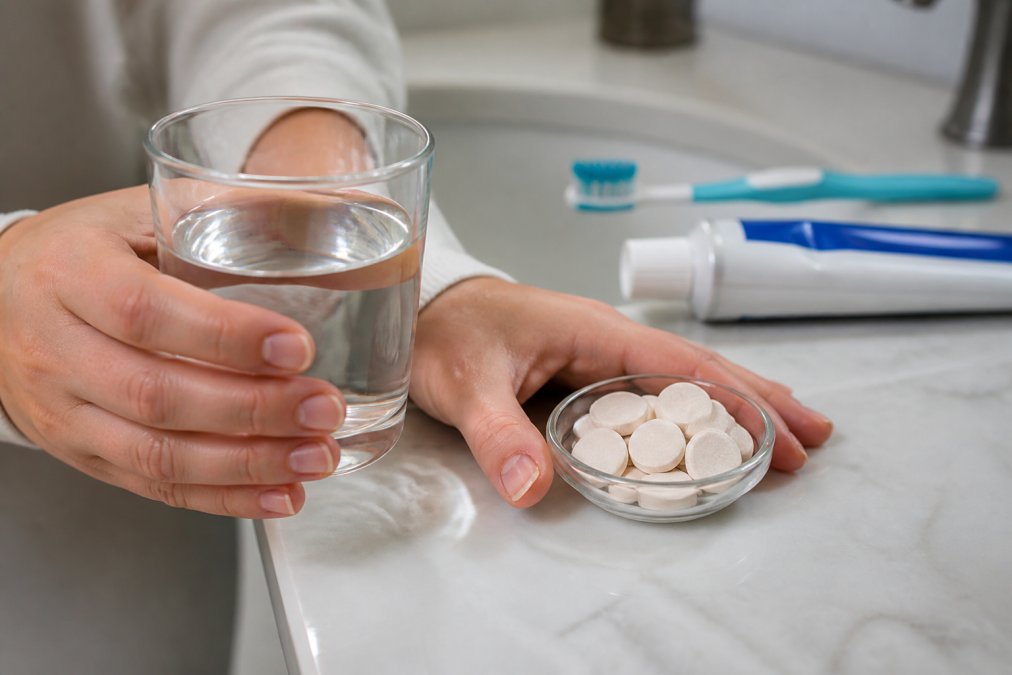
A practical checklist for evaluating any option:
- Strain codes listed, not just genus and species
- CFU count stated on the label with an expiration date
- Prebiotic support included to feed the strains
- No alcohol or harsh antimicrobials that kill the strains on contact
- Format allows 30+ seconds of contact with gum tissue
- Third-party testing or clinical validation referenced
For gum inflammation specifically, look for products that address the tissue, not just the tooth surface. Gingival health depends on what happens at the gum line, where biofilm formation starts. The American Dental Association's guidance on oral hygiene consistently emphasizes the gum line as the priority zone.
This is where PROTEITH® takes a different path. Instead of live strains, it uses proteolytic enzymes to break down the protein matrix that holds plaque together, while remaining microbiome-friendly rather than antimicrobial.
Benefits of Proteolytic Enzymes for Teeth and Gums
The benefits of proteolytic enzymes for teeth and gums center on their ability to break down proteins that bacteria use to build biofilm. Plaque isn't just bacteria. It's a protein scaffold that bacteria construct and live inside.
Enzymes like those in proteolytic formulas digest that scaffold. When the matrix breaks down, plaque releases more easily from the gum line, and bacteria lose their foothold. This is a mechanical approach rather than a biological one, which means it doesn't depend on live strains surviving storage or saliva.
Three practical advantages stand out:
- No colonization window. Enzymes act on contact, so a short brushing or swishing session still does work.
- Compatible with probiotics. Enzyme-based products don't wipe out beneficial bacteria the way alcohol-based rinses can.
- Systemic potential. A product that doubles as a dietary supplement can support the immune system beyond the mouth, which matters given the systemic health link between gum inflammation and whole-body wellness.
The honest limitation: enzymes don't repopulate the microbiome. They clear the field. If you want new beneficial bacteria to move in, you still need either probiotics or dietary support.
How to Improve Oral Microbiome Alongside Probiotics
Improving your oral microbiome takes more than adding a supplement. The bacteria you feed matter as much as the bacteria you introduce, and most routines sabotage the good strains before they can establish. This is also where the two questions most guides never answer come up: does a probiotic replace your mouthwash or floss, and what happens when you stop taking it?
Start with what you remove. Alcohol-based mouthwash, harsh whitening strips, and abrasive toothpastes all disrupt bacterial balance. If you're using a probiotic and an antimicrobial rinse in the same routine, you're paying for bacteria and then killing them. Most practitioners suggest spacing them at least 30 minutes apart, and ideally switching to a microbiome-friendly rinse so you're not undoing the colonization you just paid for.
Timing relative to toothpaste matters more than most people realize. Many toothpastes contain fluoride, and fluoride is antimicrobial at the concentrations used in oral care. If you take a probiotic tablet immediately after brushing, you're exposing the strains to a fluoride-rich environment that can reduce their viability. A common pattern is to brush first, wait 20 to 30 minutes, then take the probiotic so the strains have a cleaner surface to colonize. If your probiotic is a toothpaste itself, this conflict doesn't apply the same way, which is one practical advantage of the toothpaste format.
Then focus on prebiotic support. Fiber-rich foods, plus compounds naturally present in some oral care formulas, give beneficial bacteria something to consume. Salivary pH also plays a role. Frequent snacking and sugary drinks push pH toward acid, which favors pathogenic bacteria and demineralizes enamel. Staying hydrated and limiting grazing between meals helps keep pH in a range that favors the strains you're trying to establish.
The sustainability question is the one users ask most and guides answer least. When you stop taking an oral probiotic, the introduced strains generally don't persist indefinitely. The oral microbiome tends to drift back toward its baseline composition over days to weeks without continued exposure, because colonization is a competition and the resident community reasserts itself. That doesn't mean supplementation was pointless. It means the benefit is maintenance-based, like brushing, not a one-time reset. If you want the shift to hold, you either keep supplementing or change the environment (diet, pH, hygiene habits) so the new balance is self-sustaining.
Consistency beats intensity here. Daily supplementation with a stable routine does more for microbial diversity than sporadic deep cleaning, and the routine matters more than the price tag once you account for how long you'll actually keep it up.
Cost, Convenience, and Daily Routine Fit
Cost-per-dose is the metric most buyers ignore, and it's the one that actually determines whether you stick with a product. A cheap option you abandon after two weeks costs more than a pricier one you use daily for a year.
To calculate it honestly, divide the total package cost by the number of doses, then factor in how many products it replaces. A single product that handles gum support, stain removal, and breath freshening may cost more per unit than a basic toothpaste but less than buying three separate items.
Convenience follows the same logic. Probiora's tablet format adds a step to your routine. Superteeth replaces your existing toothpaste, so it adds nothing. PROTEITH® combines oral care with supplement benefits, which means one purchase instead of two.
The real question isn't which is cheapest. It's which one you'll actually use every day. PROTEITH® pricing depends on quantity, dates, and delivery, so check the website for current pricing rather than relying on third-party estimates.
Conclusion
The gap between a product that works and one that sits on your shelf comes down to format, strains, and whether it fits a routine you'll keep. Probiora and Superteeth each solve part of the problem. Neither doubles as a dietary supplement, and neither was built around proteolytic technology.
PROTEITH® was. It's clinically validated, free from harsh abrasives and artificial additives, and designed to support healthy gums and teeth while freshening breath and reducing the bacteria that contribute to tartar. Because it doubles as a dietary supplement, it supports your immune system and long-term wellness through systemic absorption, not just surface cleaning.
Get started with PROTEITH® and give your oral care routine a product that works on your mouth and your body at the same time.
Frequently Asked Questions
Do oral probiotics actually improve dental health?
Clinical research suggests certain strains can support gum health by crowding out pathogenic bacteria and supporting a balanced oral microbiome. However, results depend on strain specificity, colony forming units, and how consistently you take them. Dental probiotics are a complement to brushing and flossing, not a replacement. Look for products listing specific strains and CFU counts on the label, and give them several weeks of daily use before judging results.
What are the main differences between Probiora and Superteeth for teeth?
Both are dental probiotics marketed for gum health and fresh breath, but they differ in strain selection, delivery format, and supporting ingredients. Probiora typically focuses on chewable tablets with a defined strain blend, while Superteeth may combine probiotics with other oral care ingredients. When comparing dental probiotics for gum health, check the strain names, CFU counts, and whether the formula includes prebiotic support. Your oral hygiene routine and sensitivity level should guide the choice.
How do proteolytic enzymes support oral health?
Proteolytic enzymes break down proteins, including the protein matrix that makes up plaque and biofilm on teeth and gums. By disrupting biofilm formation, they can help reduce plaque buildup and support gum comfort. The benefits of proteolytic enzymes for teeth include cleaner-feeling teeth, reduced tartar formation, and fresher breath. They work well alongside probiotics because a cleaner surface gives beneficial bacteria a better chance to colonize.
Can oral probiotics replace traditional brushing and flossing?
No. Dental probiotics support bacterial balance, but they do not physically remove plaque or food debris. Brushing twice daily and flossing remain the foundation of oral hygiene. Think of probiotics as a supplement to your routine, not a substitute. If you want to improve your oral microbiome, combine mechanical cleaning with strain-specific probiotics and limit sugary snacks that feed pathogenic bacteria.

